
My product management workflow is now almost entirely thinking. Grunt work such as research, raw analysis, even typing — I've offloaded most of it to Claude Code skills I've built over the past few months.
Not all skills are created equal. A Jira shortcut or a TDD runner can be a single file with clear instructions. A professional-grade investment report narrative will require a more sophisticated architecture.
And once a skill has multiple phases, sub-agents writing to disk, and outputs that need to be reproducible, you're building a system. Systems fail in ways that simple instructions don't.
After hundreds of iterations at that complexity level, I've learned more from the failures than the successes. These ten principles are the non-negotiable rules baked into my skill-maker skill — a skill that helps me builds other skills. These rules let me consistently one-shot new skills that land ~80% of the way there on the first run.
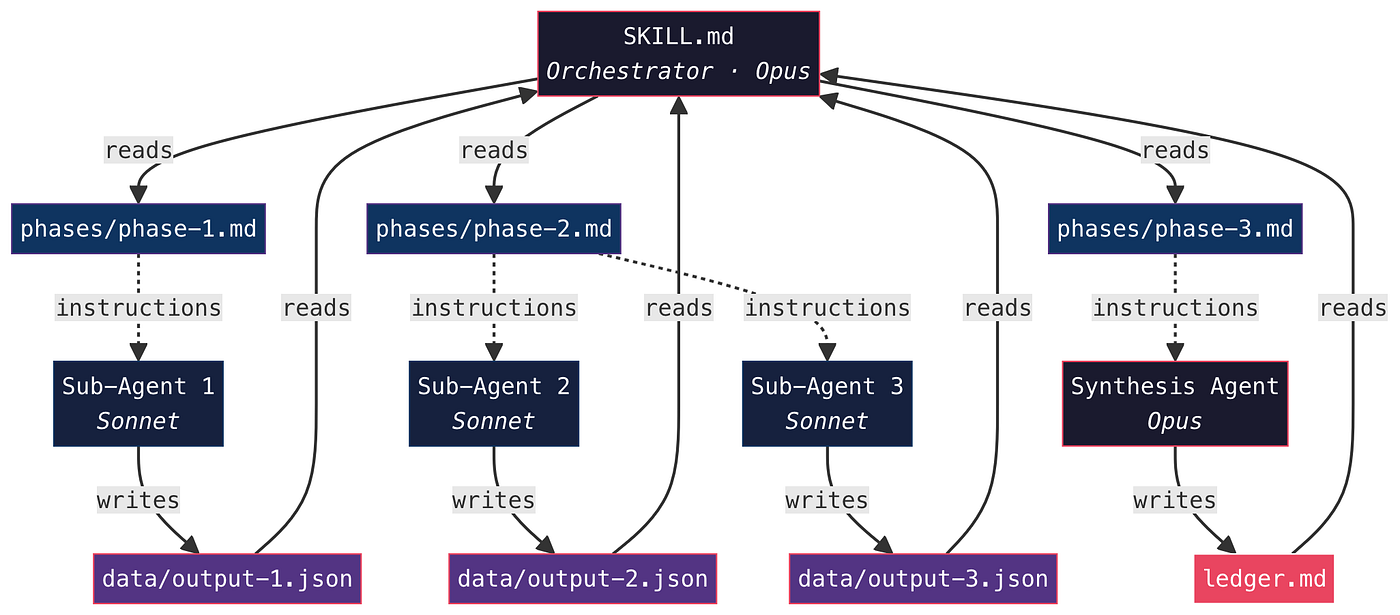
I. Thou shalt separate Agent concerns
The SKILL.md is the single orchestrator, and is executed by a single Agent. Work is executed by sub-agents, whose reasoning output never reaches the orchestrator.
II. Thou shalt instruct Agents from static files
Instructions live in phases/*.md on disk, and must be self-contained.
III. Thou shalt ground Agents in files
Design every Agent interaction as: read file, do work, write file. The files are the system.
IV. Thou shalt tithe wisely between models
Only the orchestrator needs to be smart. Sub-agents are labor, not judgment — pay accordingly.
V. Thou shalt not let two Agents write the same file
Partition writes by Agent. The Orchestrator is the only entity that reads across all of them.
VI. Thou shalt only let Agents append
Time travel is easier when you don't change the past.
VII. Thou shalt not let Agents self-validate
An Agent that produces garbage is not a failure. An Orchestrator that feeds garbage to the next phase is a failure.
VIII. Thou shalt instruct Agents to fail clearly
Silent failures are invisible poison, and will make your well of knowledge undrinkable.
IX. Thou shalt use the ledger as the ground truth
Any human output or work downstream should be reproducible using the ledger and supporting files.
X. Thou shalt not optimize the Commandments
There should never be an eleventh commandment. There be monsters beyond this basic implementation, filled with unpassable bridges guarded by ugly trolls that ask for the Business Value and the Concrete Benefits of your improvements.
Stop now and avoid unending suffering.