GLM and Hy4 weights arrive with different serving requirements
GLM-5.3’s promised weights are now available alongside Tencent’s Hy4 preview, but their shared 1M-context label hides different serving requirements. GLM keeps the previous base and makes FP8 the default checkpoint; Hy4 uses sparse attention with index reuse across layers. The linked recipes document supported setups, not independently reproduced performance.
updates 2026-08-21 · prior evidence ↗
🎉 Congrats to @Zai_org on opening the GLM-5.3 weights, the largest model in the GLM-5.3 line. Day-0 support in vLLM. 744B total, 40B active, 1M context, 128K max output. @Zai_org kept the GLM-5.2 base and scaled post-training instead, so nothing under the model changed. vLLM…
🎉 Congrats to @Zai_org on opening the GLM-5.3 weights, the largest model in the GLM-5.3 line. Day-0 support in vLLM. 744B total, 40B active, 1M context, 128K max output. @Zai_org kept the GLM-5.2 base and scaled post-training instead, so nothing under the model changed. vLLM serves it on the GLM-5.2 path, unchanged: same glm47 and glm45 parsers, same MTP out of the checkpoint, same FP8 KV cache to the full 1M. vllm serve zai-org/GLM-5.3 -tp 8 🔗 https://t.co/pVrP62ZCRR
@TencentHunyuan's Hy4-preview runs in vLLM from day 0, verified on NVIDIA GPUs. 🎉 - 770B total, 49B active, 256 routed experts plus one shared - 1M context, but each query attends to just 2048 tokens - Only 21 of the 78 layers compute their own sparse index, the other 57 reuse…
@TencentHunyuan's Hy4-preview runs in vLLM from day 0, verified on NVIDIA GPUs. 🎉 - 770B total, 49B active, 256 routed experts plus one shared - 1M context, but each query attends to just 2048 tokens - Only 21 of the 78 layers compute their own sparse index, the other 57 reuse one - A 10B MTP layer ships inside the checkpoint, 0.7B of it active, draft depth 3 Tencent's HPC-Ops attention and MoE kernels have been in vLLM main since Hy3. VLLM_ENABLE_HPC_OPS=1 vllm serve tencent/Hy4-preview-FP8 -tp 8 Thanks @TencentHunyuan for the preview weights! 🙌 🔗 https://t.co/REAxUUfyZb
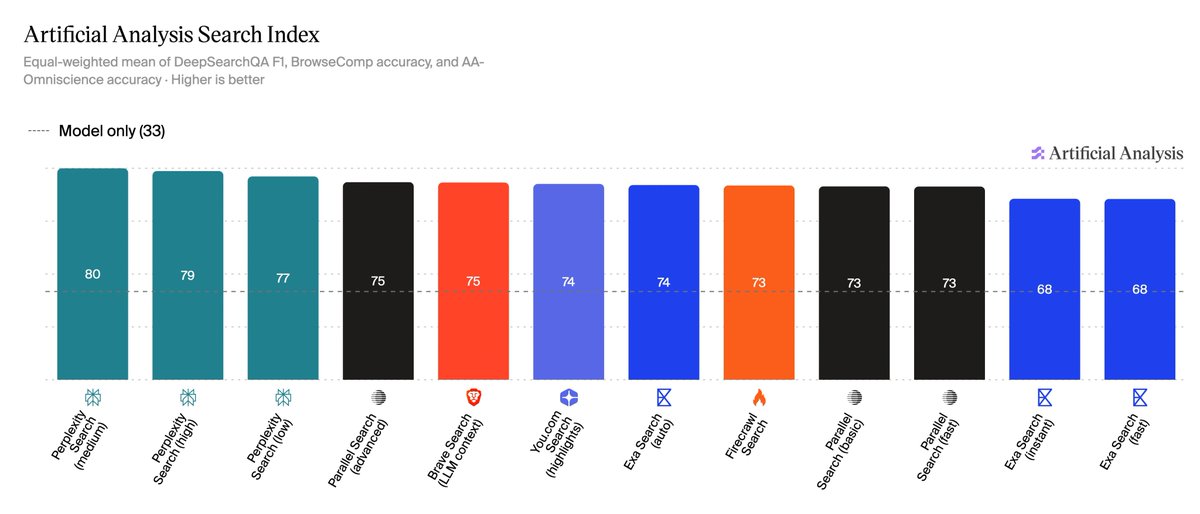
We tested one API from Perplexity with three different context sizes. The search context size setting controls how much extracted content each search result carries. All three variants have the same search price of $5.00 per 1k queries, so richer context does not cost more per search. Quality plateaus between medium and high, while searches per task (15.4 / 12.5 / 11.4) and total cost per task (~$0.105 / ~$0.091 / ~$0.091) fall with higher search context sizes. Time per task is longer with low context, driven by additional searches and model inference time.