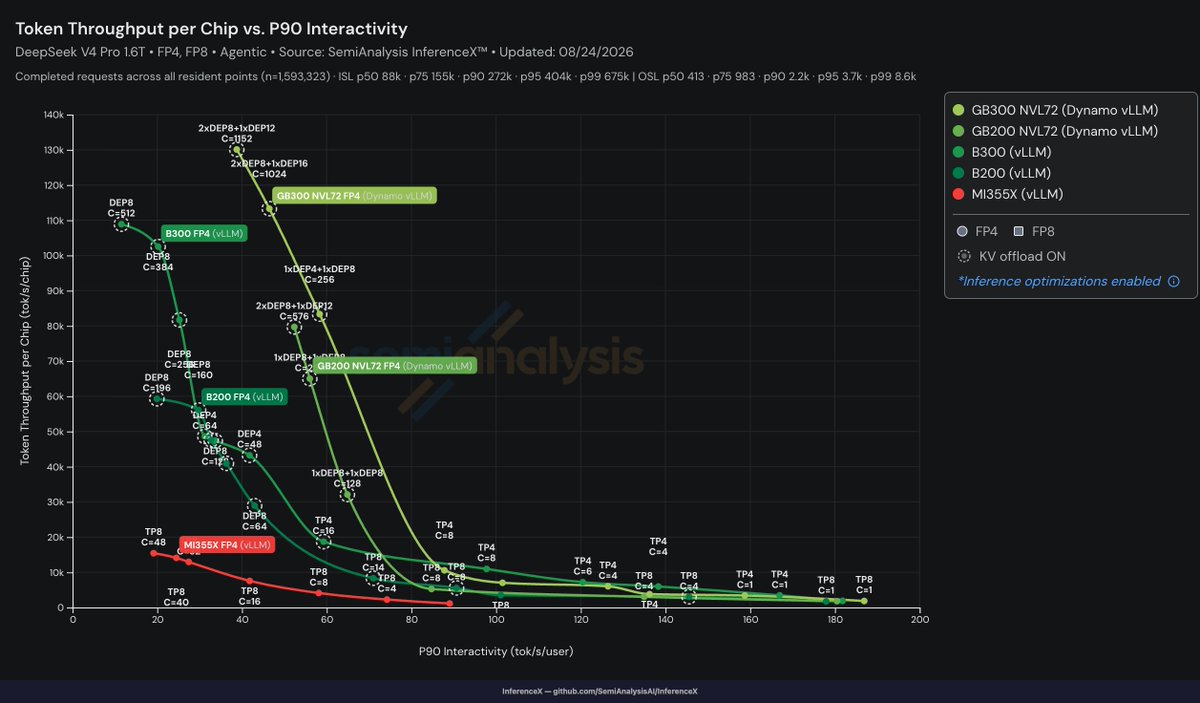
Agentic inference became a cache-and-topology problem
vLLM moved AgentX from benchmark to implementation: sparse retention kept prefix-cache hit rates above 95% at 14 concurrent requests, while disaggregated prefill and decode raised throughput 4.45× at 60 tokens per second on one DeepSeek V4 Pro setup. Separately, Artificial Analysis measured about 3,400 tokens per second at both 10K and 100K input lengths on NVIDIA’s Groq 3 LPX rack. These are vendor-specific tests, but together they show long-context serving being optimized around cache reuse and request topology rather than model kernels alone.
Congratulations to @SemiAnalysis_ on the release of AgentX 1.0 🎊, an open-source multi-turn agentic coding benchmark collected from ~$3M of real traces, running on 1000+ chips and ~2MW of continuously operated compute.
We are excited to see @vllm_project’s competitive…
Congratulations to @SemiAnalysis_ on the release of AgentX 1.0 🎊, an open-source multi-turn agentic coding benchmark collected from ~$3M of real traces, running on 1000+ chips and ~2MW of continuously operated compute.
We are excited to see @vllm_project’s competitive performance on frontier open models:
🔷130,093 tok/s/chip for DeepSeek V4 Pro
🔷 77,079 tok/s/chip for Minimax M3
🔷 12,479 tok/s/chip for Kimi K3.
The following thread covers an overview of the work from @vllm_project and @inferact: what we tested, found, and shipped upstream. This work highlights vLLM’s performance on real-world workloads and our committed focus to making vLLM an agentic-first engine.
Optimizing AgentX performance meant tackling three major challenges: prefix reuse, efficient long context parallelism, and scaling performance with PD disaggregation.
First, long agentic sessions stress prefix caching and KV cache offloading. Modern hybrid models have greatly reduced the required KV cache sizes, and caching every block boundary still saturates the KV cache pool which causes prefix cache thrashing across sessions.
The fix was sparse retention: one state per interval-sized segment plus the latest replay boundary (vllm-project/vllm #43447, #45845), then preserving shared-prefix boundaries so the interval can go to 0 for agent sessions (#47782). That gets us >95% hit rate at 14 concurrent requests with contexts to 1M.
The bigger structural change in KV cache offloading was making the shared KV pool distributed. With Mooncake Store as a first-class connector, prefill ranks can hit the prefix cache both within a worker and across workers, so we no longer have to trade cache locality against load balance to keep a cluster busy. Session-aware routing (48048) is what lets the router act on it.
For a single node deployment, SimpleCPUOffloadConnector has been greatly improved to support all hybrid model architectures and across both CUDA and ROCm platforms. For DeepSeek V4 Pro on ROCm, this implementation gave +81.7% output throughput and 46.6% lower mean e2e latency versus recomputing the prefix.
Kimi K3 at 2.8T barely fits on a single node, and squeezing it in leaves almost no headroom for KV cache, which is exactly what a long multi-turn session needs most. Parallelism strategy matters more here than on any other model we tested.
TP8/DCP8 tops the K3 agentic frontier across configs, with B300 vLLM peaking at ~12.5k tok/s/chip at ~8 tok/s/user and GB300 NVL72 on Dynamo + vLLM holding the curve out past 200 tok/s/user. K3 also surfaced a routing bug worth pulling: vllm-project/router#194 fixes the router dropping reasoning_content, which hits any reasoning model served behind it.
On MiniMax M3, B200 vLLM reaches ~44k tok/s/chip and vLLM leads TRT-LLM on throughput vs p90 TTFT. M3 and Qwen3.5 both shipped day-0.
Finally, fully optimized performance requires scaling the deployment with prefill-decode disaggregation and distributed KV cache offloading. Thanks to vLLM’s MultiConnector, this is natively supported with NIXL PD connector + MooncakeStoreConnector. By rate matching to find the ideal prefill-decode ratio, we achieved 4.45x higher throughput at a 60 tok/s interactivity for DeepSeek V4 Pro on GB300 Dynamo compared to B300.
Shoutout to @NVIDIAAI, who co-tuned most of these configs with us. Dynamo's router optimizations took AgentX replay time down 23.7% on the vLLM backend, the AIPerf replay harness is what made the traces runnable at all, and NIXL and their kernels sit under each respective performance point.
Shoutout to @AIatAMD as well: the team’s AITER sparse-MLA decode selection led to +5.22% AgentX output throughput; the hybrid AITER/native CSA selector led to 1.21–1.76x e2e performance boost, and the team made prebuilt lmcache gfx942/gfx950 wheels and a published Mooncake ROCm wheel.
Thank you to @SemiAnalysis_ for building AgentX and for the collaboration throughout. Agentic workloads are what users serve in real production, and benchmarking on real workloads is what improves vLLM and open source inference.
Next up: more upstream work and a blog with a full technical deep dive later this week. Stay tuned. 🚀
Artificial Analysis has measured 3,431 tokens/s on Gemma 4 31B via a private demonstration endpoint for NVIDIA Groq 3 LPX - the highest 100k-context output speed we have measured for Gemma 4 31B on either a private or public endpoint
@nvidia announced today that the Groq 3 LPX…
Artificial Analysis has measured 3,431 tokens/s on Gemma 4 31B via a private demonstration endpoint for NVIDIA Groq 3 LPX - the highest 100k-context output speed we have measured for Gemma 4 31B on either a private or public endpoint
@nvidia announced today that the Groq 3 LPX ‘interactive AI inference’ rack is in full-scale production and will enter operation later this year. NVIDIA granted us early access to a private deployment of the rack serving Gemma 4 31B for benchmarking purposes
We ran the standard 1k, 10k and 100k input sequence length prompts that we use for benchmarking serverless API providers. At both the 10k and 100k input sequence lengths, the endpoint delivered a median output speed of approx. 3,400 tokens/s, measured over 50 sequential (single-concurrency) requests. Output speed was maintained between the 10k and 100k input sequence lengths tested, indicating robust long-context inference performance
Congratulations to the @nvidia team on the launch!
The benchmark mattered on August 23; this engineering account shows what changed underneath it. Sparse retention reduced prefix-cache thrashing, distributed KV offload separated cache locality from load balancing, and prefill/decode disaggregation exposed a rate-matching problem. The numerical gains are configuration-specific, but the durable lesson is architectural: long agent sessions force cache policy, routing, and serving topology to be designed together.
Signals
No single-source signals cleared the bar today.
Sentiment
Inference stacks specialized for agents+0.46
3 posts · 92% confidence
Themes
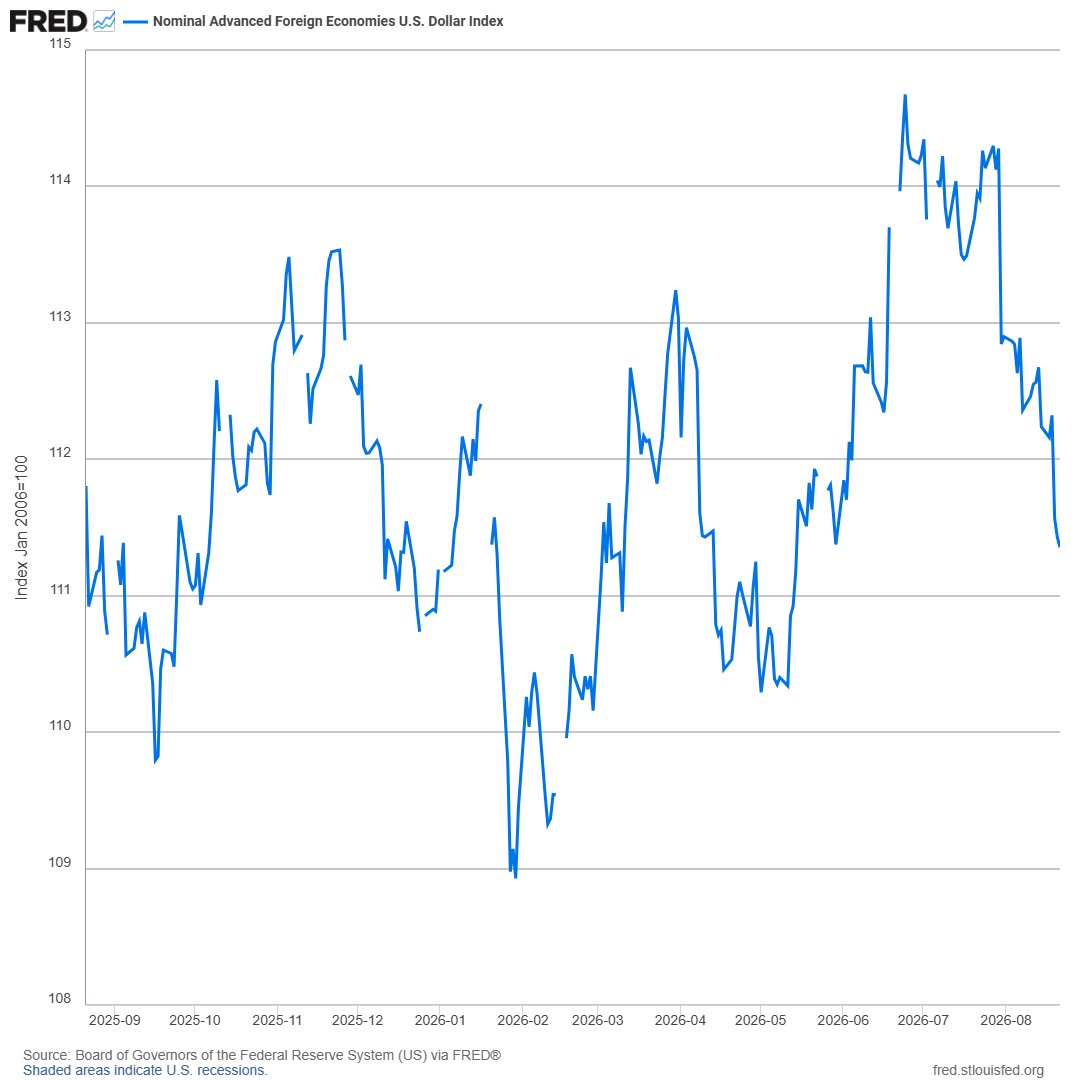
Dollar weakness revived the debasement trade
The Federal Reserve’s advanced-economy dollar index, a nominal trade-weighted measure, was 111.3552 on August 21, a three-month low. Nikkei reported gold and bitcoin at three-month highs, signaling a renewed hedge narrative without implying causation.
Daily trade-weighted U.S. dollar index declined to a three-month low of 111.4 as of Aug. 21 (January 2006=100). See this index and more data from the @federalreserve Foreign Exchange Rates - H.10 release in FRED: https://t.co/lzDiUS0Utf https://t.co/XNcL9lG7ia
Using RAPIDS records from 2016–2025, the Richmond Fed finds rural areas accounted for 18% of new registered apprentices in 2025, up from 15% in 2016. Rural starts grew 16% from 2023 to 2025 versus 6% in urban areas, and ages 16–24 explained more than half of the recent rural increase. The state-level dispersion matters: the national trend is real, but access still depends heavily on local program structure.
Five decades of CPS ASEC data show why hourly and annual college premiums follow different career paths. The annual-earnings ratio starts above 2 and trends toward 1.8, while the hourly-pay ratio begins around 1.6–1.7 and rises. Early in a career, much of the annual gap therefore comes from steadier full-time, full-year work rather than wages alone—a useful distinction for returns-to-education models.